

Homeschooling Statistics : Surprising Special Education Data
Wondering about Homeschooling Statistics : Who homeschools and Why?
My Master’s Degree Project focused on home schooling children with specific learning disabilities. Below, are the homeschooling statistics stemming from polls listed on home schooling Listservs.
These homeschooling statistics are regarding the population of homeschooling students who have learning disabilities. A poll was conducted in an online group with 470 members. It primarily consists of parents home schooling children with specific learning disabilities, and 62 responses came through.
Why Parents Homeschool
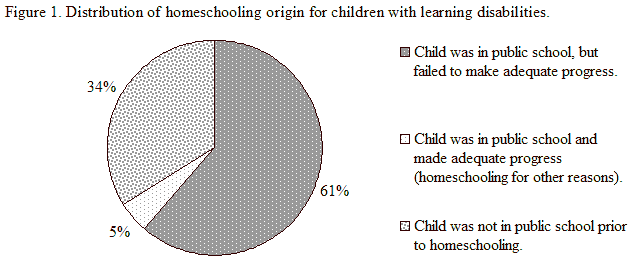
Of those responding, 61% previously had their child enrolled in public school. Most are home schooling because the child was failing to make adequate progress (Figure 1). Among the remaining parents, 34% did not previously enroll their child in public school. 5% of the children were previously enrolled in public school and the child made adequate progress. However, the child is being homeschooled for other reasons.
This distribution is important among homeschooling statistics because a failure to make adequate progress in public school indicates the child is probably already below grade-level when home schooling begins.
Additionally, the parents enrolled their children in public school initially. This indicates they were not originally planning on home schooling. The parents would experience an unplanned learning curve in both home schooling methods and remedial teaching.
Homeschooling Disabilities Distributions
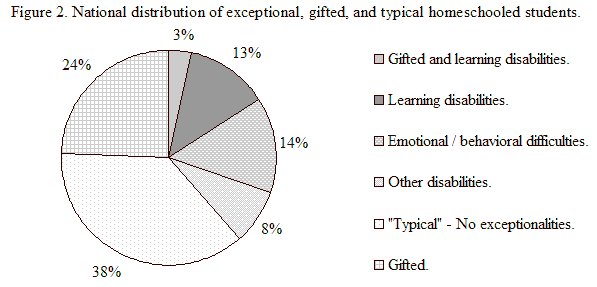
To determine the distribution of exceptionalities among homeschooling students, an online poll was conducted in a general interest home schooling listserv. It had 1550 members, and in 119 responses came in. Poll results show 38% of the students are represented by their parent as being ‘typical.’ 24% are identified as being gifted, and 38% are identified as having special education needs (Figure 2).
Twice exceptional students are those who hare both giftedness and learning disabilities. Their data overlaps with the gifted and special education categories and account for 3.0% of the children represented.
At a percentage of 38%, the homeschool student body with special education needs would be approximately 38,000 students out of every 100,000. That is almost three times higher than the number of students in public school special education programs.
Students with specific learning disabilities account for approximately 16% of the homeschooling population (SLD and twice exceptional combined). That equals about 16,000 out of every 100,000 students. This percentage is more than two and half times the number in public school special education programs. It is one of the eye-opening homeschooling statistics.
Popular Homeschooling Grades
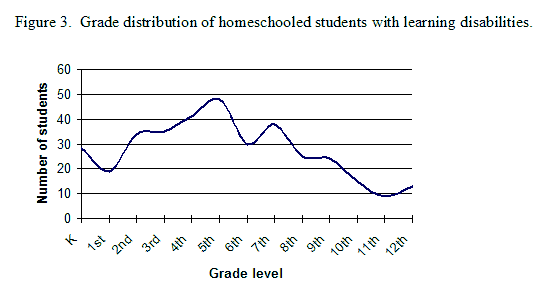
The grade levels for homeschool students with learning disabilities distributes among all K-12 grades. Students are an average of 1.6 grades behind in achievement, when comparing with the child’s age-based grade level.
The grade-level distribution shows the highest number of homeschool students with learning disabilities occurs in grades four through seven. There is a drop in the number of students occurring in the sixth grade, at the beginning of middle school.
The peak occurs in the fifth grade, with 24% of students being in fifth grade (Figure 3). The number increases around the fourth grade, most likely because students with learning disabilities fall further behind peers more rapidly in the third and fourth grade.
After the seventh grade, the number of homeschool students with disabilities drops off. The number is likely to drop for several reasons.
First, many parents do not wish to attempt home schooling through high school.
Second, students sometimes seek to have greater interaction with peers at the high school level, therefore they may request to return to school.
Third, if a child has been successfully homeschooled, his remedial skills may be at a level where re-integration into public school is easily accomplished.
As far as homeschooling statistics go, the grade levels is most important to consider in developing programs. It’s important to support the larger number of students homechooling in grades 2-7.
If you would like to see the full survey results and all of the homeschooling statistics, with 200 respondents, go to:
Learning Abled KidsMulti-Sensory Survey Results – with 200 participants. For additional homeschooling statistics, you may want to see the research at http://www.nheri.org/.
THANK YOU SOOOOOO MUCH!!
Best Wishes, Sandy
—
